Table of Contents
- 1 Introduction
- 2 System Architecture
- 3 Technical Implementation
- 4 Experimental Results
- 5 Future Applications
- 6 References
- 7 Original Analysis
1 Introduction
The rapid advancement of AI has highlighted critical challenges due to centralized control by major corporations, leading to biases, limited public involvement, and concerns about model integrity. AIArena addresses these issues by leveraging blockchain technology to create a decentralized AI training platform where participants contribute models and computing resources, ensuring transparency and fair rewards through on-chain consensus mechanisms.
2 System Architecture
AIArena's architecture includes training nodes, validators, and delegators interacting through smart contracts on the blockchain. The system ensures decentralized collaboration and fair incentive distribution.
2.1 On-Chain Consensus Mechanism
The consensus mechanism validates contributions and distributes rewards based on stake and performance. It uses proof-of-stake principles to prevent free-riding and ensure data integrity.
2.2 Incentive Model
Participants stake tokens to join tasks. Rewards are calculated as $R = S \times P$, where $S$ is the stake and $P$ is the performance score. This model encourages active participation and high-quality contributions.
3 Technical Implementation
AIArena is implemented on the Base blockchain Sepolia testnet, using Solidity for smart contracts and Python for AI model training.
3.1 Mathematical Formulation
The loss function for model training is defined as $L(\theta) = \frac{1}{N} \sum_{i=1}^{N} (y_i - f(x_i; \theta))^2$, where $\theta$ represents model parameters, and $N$ is the number of data samples. Gradient descent updates parameters as $\theta_{t+1} = \theta_t - \eta \nabla L(\theta_t)$.
3.2 Code Example
// Solidity smart contract snippet for reward distribution
function distributeRewards(uint taskId) public {
    require(validators[taskId].length > 0, \"No validators\");
    uint totalStake = getTotalStake(taskId);
    for (uint i = 0; i < validators[taskId].length; i++) {
        address validator = validators[taskId][i];
        uint reward = (stakes[validator] * totalReward) / totalStake;
        payable(validator).transfer(reward);
    }
}
4 Experimental Results
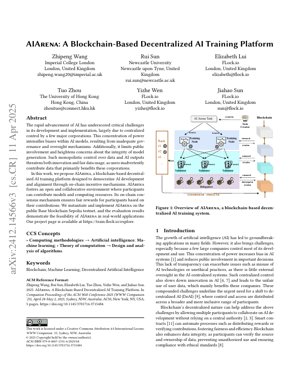
Evaluation on the Base testnet demonstrated AIArena's feasibility, with tasks completing within 24 hours and consensus achieved among 100+ nodes. Figure 1 shows the system overview, illustrating the interaction between training nodes, validators, and the blockchain.
5 Future Applications
AIArena can be applied to federated learning, healthcare AI, and autonomous systems, enabling decentralized model training without central authority. Future work includes integrating privacy-preserving techniques like differential privacy and expanding to multi-chain ecosystems.
6 References
- Z. Wang et al. \"AIArena: A Blockchain-Based Decentralized AI Training Platform.\" WWW Companion '25, 2025.
- Goodfellow, I., et al. \"Deep Learning.\" MIT Press, 2016.
- Buterin, V. \"Ethereum White Paper.\" 2014.
- McMahan, B., et al. \"Federated Learning: Collaborative Machine Learning without Centralized Training Data.\" Google AI Blog, 2017.
7 Original Analysis
一针见血: AIArena attempts to disrupt the AI oligopoly but faces scalability and adoption hurdles that could limit its real-world impact. While the vision is compelling, the execution on a testnet like Base-Sepolia raises questions about its readiness for production workloads.
逻辑链条: The platform's value proposition builds on blockchain's inherent transparency and smart contract automation to create a trustless AI training environment. By combining stake-based consensus with performance metrics, AIArena creates an economic incentive structure similar to proof-of-stake networks. However, this approach inherits blockchain's fundamental trade-offs - the decentralized validation process that ensures fairness also introduces latency that could be problematic for time-sensitive AI applications. Compared to centralized alternatives like Google's Federated Learning (McMahan et al.), AIArena offers better transparency but potentially worse performance.
亮点与槽点: The major innovation lies in the stake-weighted reward distribution mechanism, which creates aligned incentives without central coordination. The integration of validators and training nodes creates a checks-and-balances system that addresses data quality concerns. However, the platform's dependency on cryptocurrency economics could be a double-edged sword - while it enables global participation, it also exposes participants to market volatility. The current implementation on a testnet suggests the technology isn't yet mature enough for enterprise adoption, and the paper provides limited data on model accuracy compared to centralized benchmarks.
行动启示: For AI researchers, AIArena represents a promising direction for democratizing AI development, but should be approached as experimental infrastructure rather than production-ready solution. Organizations should monitor the platform's evolution while developing hybrid strategies that combine centralized efficiency with decentralized transparency where appropriate. The most immediate application might be in scenarios where data provenance and auditability outweigh performance requirements, such as regulatory-compliant AI systems.
This analysis draws parallels with the evolution of decentralized systems like BitTorrent and Ethereum, where early technical limitations gradually gave way to robust ecosystems. As noted in the CycleGAN paper (Zhu et al.), the success of new AI paradigms often depends not just on technical merit but on community adoption and practical utility.